Guide · 12 min read
How to Buy Broken Appliances and Profit from the Flip
How to buy broken appliances and flip them: where to source repairable units, how to read a listing, on-location inspection tests, repair-cost math, and the red flags to walk from.
You are standing in the same spot a lot of flippers hit after a few bad buys. The listing looks promising, the price is low, and the seller keeps saying it just needs a "simple fix." Then you zoom in on the photo, notice a missing data plate, and realize you are about to spend fuel, time, and cash on something that may never turn into a clean resale.
That is the game with broken appliances. The profit is not in grabbing every cheap unit listed as-is. It is in knowing which failure modes are repairable, which channels surface inventory worth the drive, and which details separate a margin-positive flip from a parts-and-time drain.
Why buying broken appliances is a real business in 2026
The best broken-appliance deals rarely look exciting at first glance. They look like a fridge that "won't power on," a washer with a dead control panel, or a range listed by someone who already gave up on it. Those are the listings that force a buyer to decide, fast, whether the issue is a cheap part and an easy resale, or a costly failure that belongs in the scrap pile.
The economics are real because the price gap is real. Consumer Reports notes that older pre-owned appliances can sell for as much as 75 percent off the original retail price, while the average discount is about 50 percent, which leaves room for resale if repair costs stay controlled (Consumer Reports on used appliance pricing). Public-interest research also estimated that repair could cut household spending on electronics and appliances by 22 percent, saving an average family about $330 per year, which tells you replacement costs are high enough for repair and resale markets to capture value (Public Interest Network on repair savings).
The margin exists because replacement is expensive
That discount gap is what makes a broken unit worth studying in the first place. A seller may think "not working" means worthless, but a buyer who knows the failure pattern can see a unit that still has a strong post-repair market. The sweet spot is not scrap, and it is not perfect used inventory either. It is the middle ground where the appliance still has demand, the parts are available, and the fix is predictable enough to underwrite.
Practical rule: if the repair story is simple enough to explain in one sentence, the listing deserves a closer look. If the seller cannot explain the symptom clearly, the risk climbs fast.
That is why the word "broken" matters less than the specific fault. A loose knob, a clogged drain, or a bad seal is a different business than a sealed-system refrigerator or a control-board-heavy range. The profitable buyer keeps buying from the first bucket and walks away from the second.
The six sourcing channels that actually produce margin
The sourcing problem is not "where do broken appliances exist." They exist everywhere. The question is which channels consistently produce repairable inventory without burning half the week on dead leads. In practice, the answer comes down to volume, filtering, and how much pre-screening happens before you even see the listing.
Compare channels by the kind of work they force you to do
| Channel | Typical margin | Volume | Time per deal | Key risk |
|---|---|---|---|---|
| Aggregated deal feed tools | Strong on screened listings | High if your region is active | Low per screen | Still needs inspection and repair discipline |
| Facebook Marketplace and local classifieds | Uneven, sometimes excellent | High | High | Noise, vague descriptions, missed details |
| Estate sales and auctions | Moderate to strong | Medium | Medium | Competitive bidding, limited testing |
| Haul-away contracts | Often strong on bulk lots | Medium to high | Medium | Mixed condition, harder triage |
| Scrap-yard and recycling routes | Can be strong on salvageable units | Medium | Medium to high | Unknown history, transport damage |
| Direct outreach to sellers | Variable, often underrated | Medium | High | Slow replies, inconsistent listing quality |
An aggregated live feed compresses work that usually takes hours. Broke Fix Flip surfaces broken and for-parts listings from live feeds, estimates margin, and links to parts references and the source marketplace, which helps you avoid manually digging through irrelevant results. A tool like that does not replace judgment, but it does reduce the search tax that kills beginners (Broke Fix Flip workflow example).
Where the other five channels still matter
Facebook Marketplace and Craigslist still produce deals because sellers want speed, not retail value. That is also why the listing quality varies wildly. You will see everything from a clean "needs a relay" note to a blurry photo with three appliances stacked in a garage and no model number in sight.
Estate sales and auctions work when you can inspect quickly and bid without emotion. Haul-away contracts can be profitable because the inventory is already leaving a property, but the hidden cost is sorting. Scrap routes are best when you can move fast, identify salvageable units, and stay disciplined about what you will not take. Direct outreach to property managers, apartments, and universities still works, but it is slower and less repeatable than many people expect.
Useful filter: choose two channels for volume and one channel for quality. If every deal source needs a different playbook, you will spend more time searching than flipping.
Reading a listing before you ever message the seller
A lot of losses happen before the first text. Buyers see "untested" and treat it like a soft version of "broken," but those words are not interchangeable. The listing itself often tells you enough to decide whether the trip is even worth making, once you start reading the symptom language instead of the price tag.
Read the condition words as risk signals
"Not working" is usually more direct than "untested," because it tells you the seller already noticed a failure. "For parts only" usually means the seller has mentally moved the unit out of the resale category. "As-is" tells you there is no fallback if the machine dies after pickup. Those labels do not kill a deal by themselves, but they change how much margin you need to see before you move.
The model and serial sticker matter just as much. Consumer Reports and Wirecutter both emphasize checking the model number, serial number, and data plate before buying, and Consumer Reports says missing stickers are a reason to avoid the appliance because it could have been recalled or illegally salvaged. Wirecutter also notes the number helps estimate age and check parts support through the manufacturer or parts retailers (Wirecutter used appliance buying guidance).
What to look for in the post
- Photos of the data plate: No photo of the label usually means more uncertainty, not less.
- Specific symptom language: "Won't power on," "leaks from front left," and "drum spins but won't heat" are actionable. "Stopped working" is not.
- Pickup terms: Local pickup only can be fine for large appliances, but it also means you own the transport risk.
- Return policy: No returns is normal in private sales, but it means the math has to be tighter.
- Visible damage: Rust, odors, and broken panels should be visible before you ever ask for more detail.
The fastest way to avoid weak leads is to check the listing against a margin workflow before you message anyone. If the asking price plus likely repair already crowds the working-condition value, the deal is probably too thin. That is exactly where a spread-checker beats gut feel.
On-location inspection techniques that catch hidden defects
A seller can describe a machine as "just needs a fuse" and still be wrong. Once you are on-site, the goal is to verify the big failure buckets quickly, before you load something that only looked fixable from the driveway. A flashlight, your phone, and a basic multimeter are enough for a lot of this work.
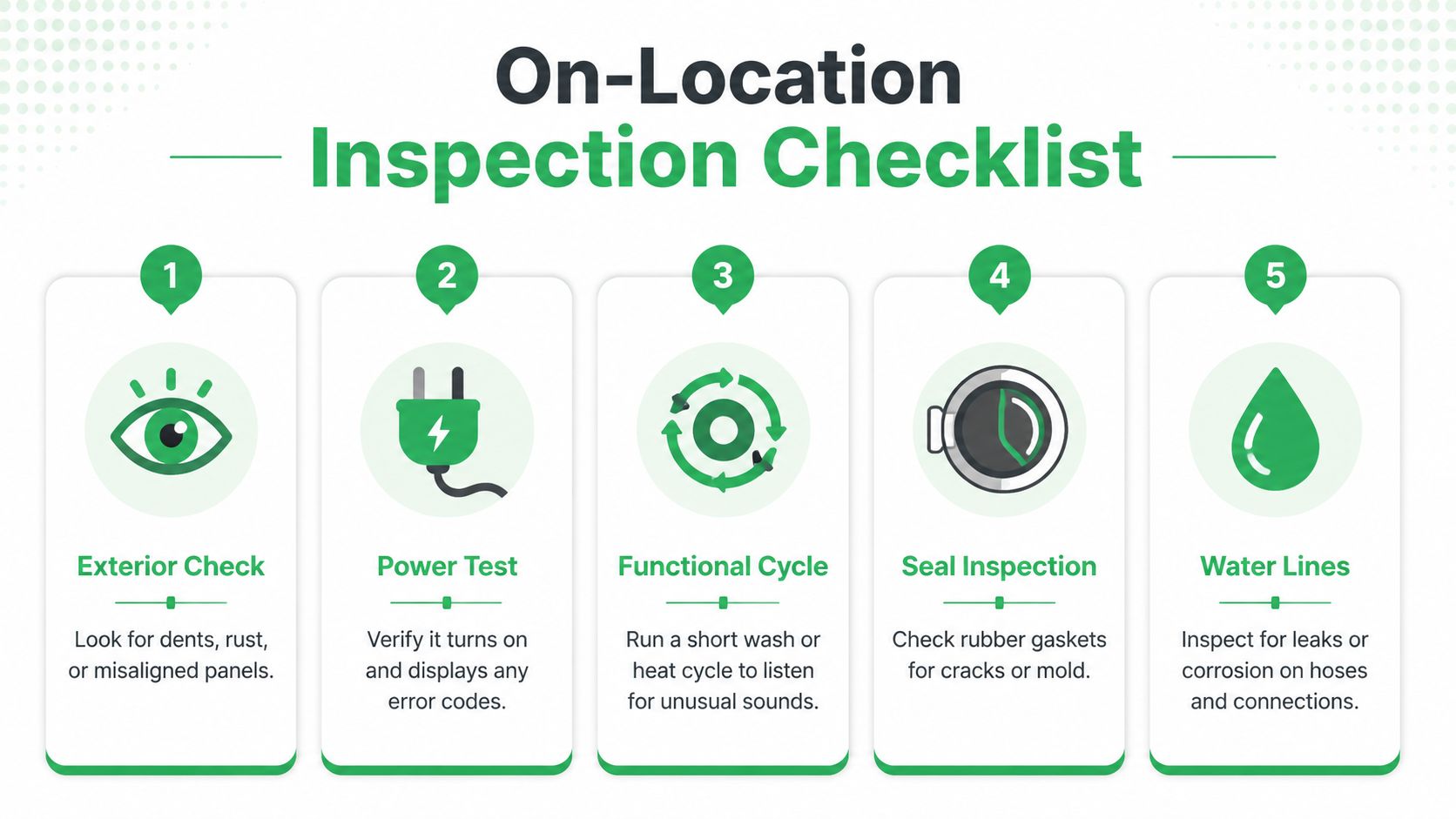
Start with the obvious failures
Look for rust, dents, odors, and water marks before you touch anything. Rust near the base usually means more than cosmetic age. Water staining around the bottom edge, under drawers, or behind a washer often points to leaks, and a musty smell can hint at mold or long-term neglect.
Then test power and controls. Plug in the unit, confirm it powers on, and cycle the controls far enough to see whether the buttons, knobs, or display respond. If the appliance will not energize at all, that is not automatically fatal, but it pushes you into a narrower set of possible fixes.
Use category-specific tests, not guesswork
For refrigerators, a common approach is to plug the unit in and let it run for 15 minutes with the doors closed, then check whether the freezer starts to feel cold using an infrared thermometer or even a bottle of water. Ripped door seals are a real issue because they let cold air escape and raise operating costs.
For washers and dryers, you are looking for fill, agitate, drain, spin, heat, and smooth drum movement. For ovens and ranges, every burner or element needs to be tested, not just the one closest to the plug. A machine can look clean and still hide a failed cycle, a bad lock, or a safety issue that only shows up under load.
Practical rule: if you cannot verify the core cycle on location, discount the unit as if one major repair is already waiting.
Keep the test short and disciplined. You are not there to fully service the machine. You are there to learn whether the failure is likely small, known, and cheap, or the kind that eats the spread before you ever list it again.
Estimating repair costs and whether the spread survives
This is where broken-appliance flipping turns from scavenging into underwriting. A good listing with a bad repair estimate is still a bad deal. The only spread that matters is the one left after parts, time, freight, marketplace fees, and a little room for surprises.
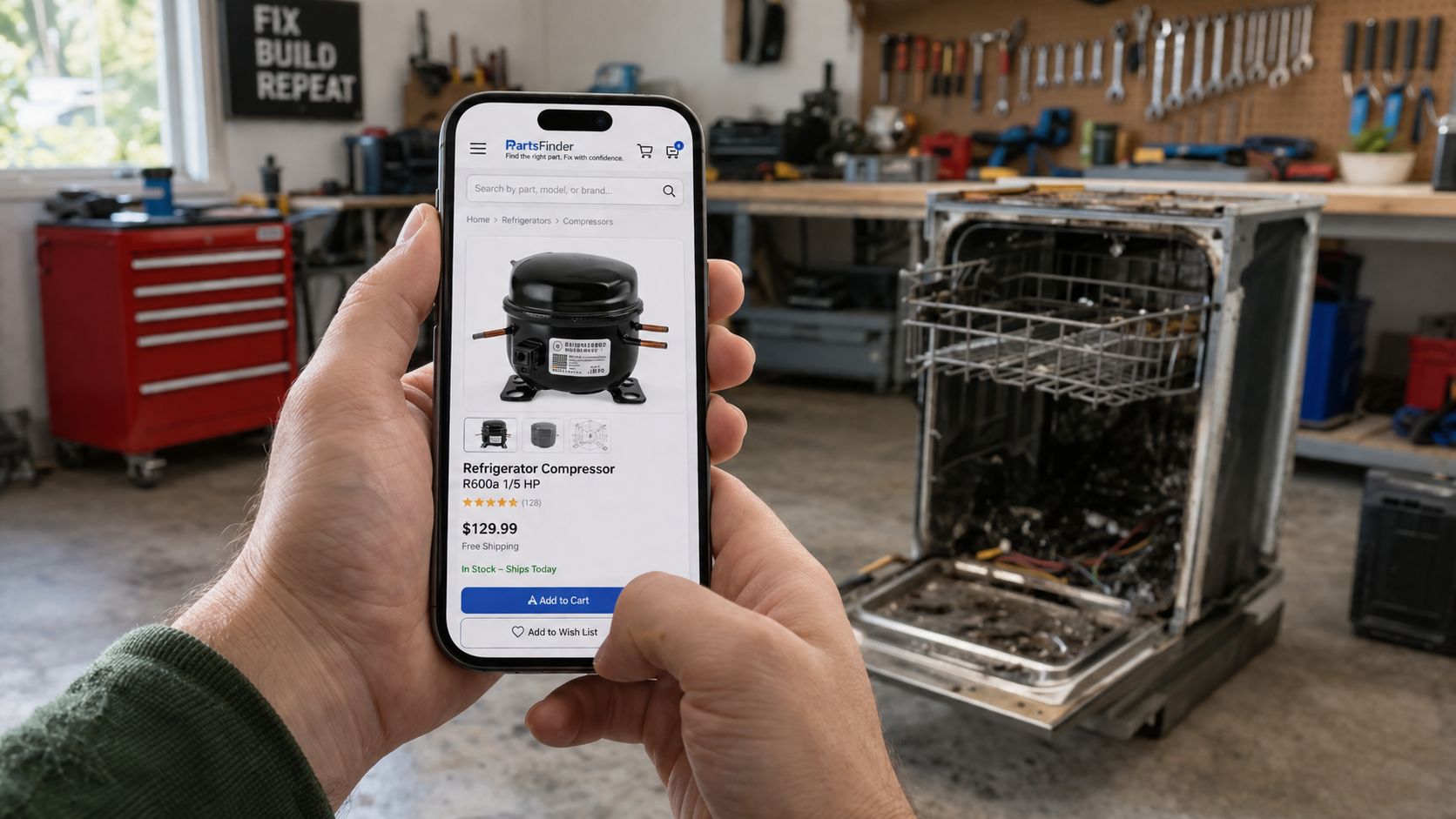
Price the fault before you price the flip
Start with the symptom and work backward. A no-power fridge could be a cord issue, a control problem, or something much worse. A washer that drains slowly may need a pump, or it may have a more annoying wiring or board issue. The point is to narrow the fault category before you start dreaming about resale value.
Then price the parts. Search by model number, not just by appliance type, because compatibility matters more than general category. Add labor if you are not doing the repair yourself, and be honest about your own time if the machine needs bench work, disassembly, or a second trip for diagnosis. A bulky pickup also needs a logistics line item, since freight or local transport can erase the margin on larger units.
Here is a clean way to think about the spread:
- Parts cost: the replacement component and any required consumables.
- Labor or bench time: your own time or a repair shop invoice.
- Transport: pickup, delivery, or freight.
- Resale friction: listing time, messages, marketplace fees, and possible returns.
- Contingency: a small cushion for the part you did not expect to replace.
Know the failure modes that usually break the deal
Some appliances are expensive when they fail in specific ways. Refrigerators with sealed-system problems can get ugly fast. Washers with inverter-board issues and ovens with control-board faults can push the repair cost past what the resale spread will support. If the estimated repair already gets close to most of the working value, the deal needs a strong reason to survive.
Practical rule: if the repair estimate feels fuzzy, treat that fuzziness as cost, not as optimism.
That is the discipline that separates a flipper from a collector of broken metal. You are not buying the story. You are buying the delta between the broken price and the repaired resale value, and that delta has to survive real-world friction.
Negotiating, picking up, and shipping without burning the margin
Once the numbers make sense, the next way to lose money is transport. A deal that works on paper can die on a steep driveway, an ignored model mismatch, or a delivery quote that eats the entire spread. The safest play is still local pickup unless the unit is small enough, and the margin wide enough, to support shipping.
Keep the seller conversation low-pressure
Ask direct questions and keep your tone neutral. "Does it power on at all?" "What did you test?" "Is the model sticker still on the unit?" Sellers usually tell you a lot by how quickly they answer and whether they stay specific. Vague answers usually mean vague testing.
The phrase "as-is, local pickup only" is common for a reason. It puts the transport burden on you and removes any assumption that the seller will help after the sale. That is fine if the spread is wide enough. It is a problem if you are already thin.
Protect yourself at pickup
Bring straps and a dolly. Photograph the appliance before loading it, including the front, sides, back, and data plate. Match the model and serial numbers to the listing before money changes hands. That small step catches swap mistakes and the occasional seller who posts one machine and points you to another.
For larger appliances, local delivery often beats freight if you can control the route and the handoff. LTL freight can make sense for a smaller countertop unit or a highly profitable item, but it gets expensive and awkward fast on full-size fridges and washers. The more bulky the unit, the more the logistics can chew into your margin.
If you need a broader resale workflow after the repair, the guide to the best places to resell used items fits into that handoff stage, especially when you are deciding whether a repaired unit belongs on a marketplace, a local pickup listing, or a different sales channel entirely.
Useful rule: if shipping turns a decent spread into a thin one, skip the deal. Another listing will show up.
The money you save by being picky on pickup day is usually larger than the money you think you are gaining by forcing a questionable shipment through.
Decision framework and red flags for your next listing
The simplest way to think about broken appliances is to split them into three buckets. Green means a simple, predictable fault with strong demand. Yellow means the fault is common but needs diagnosis and parts discipline. Red means the repair is expensive, uncertain, or likely to snowball.
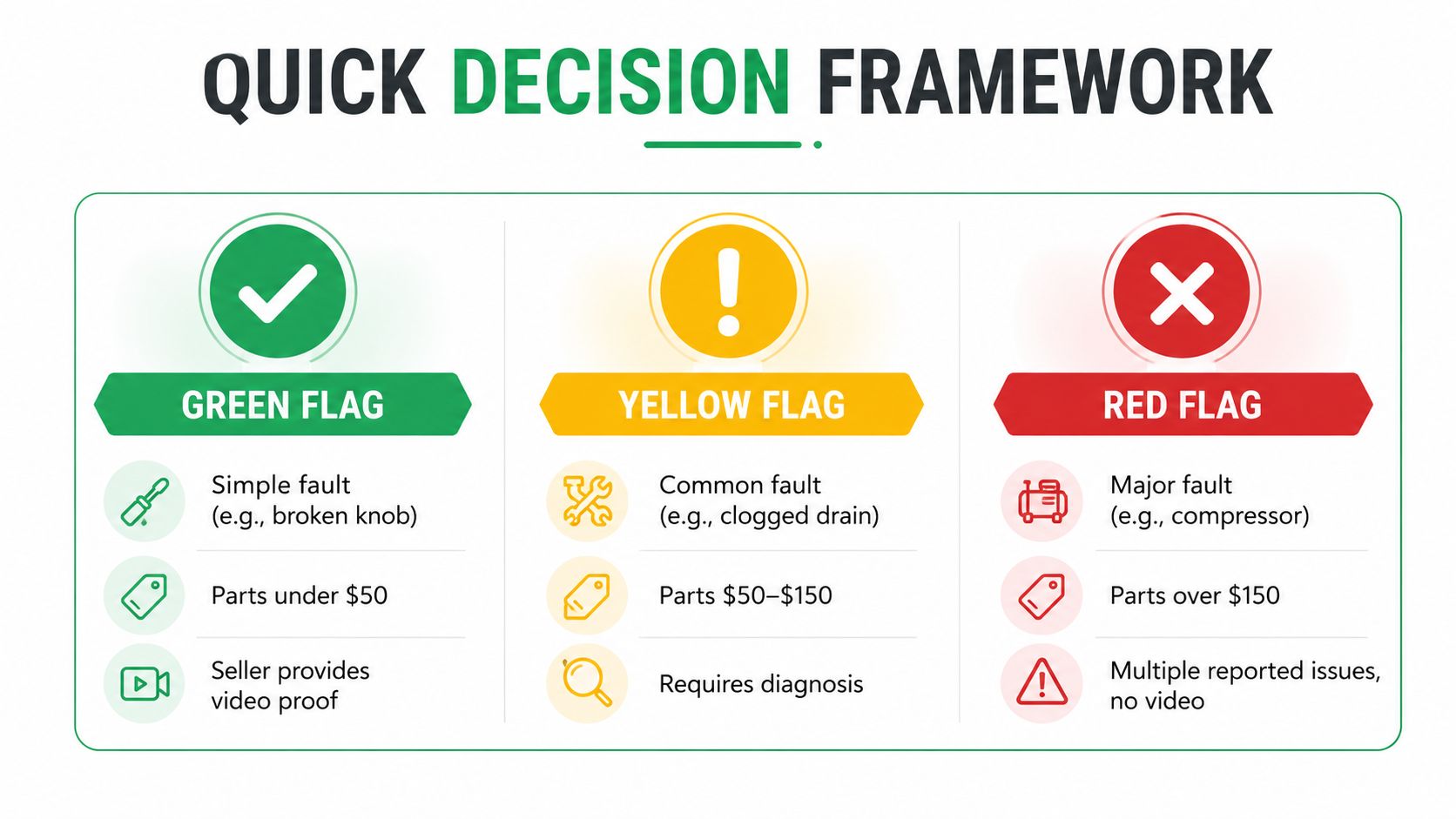
Use the listing to sort the deal fast
The green flags are easy to spot when the seller cooperates. Clean model numbers, an exact symptom, visible data plates, and parts support are all encouraging signs. A unit that powers on, shows a simple issue, and has obvious replacement parts support belongs in the "maybe" pile, not the "never" pile.
Yellow flags need caution. A clog, a seal issue, or a dead knob can still work if the price is low enough and the working-value spread is wide. The moment the seller's story gets fuzzy, though, yellow starts sliding toward red.
Red flags are usually obvious if you are paying attention. Missing serial stickers, no photos of the data plate, multiple reported issues, or a seller who will not answer basic questions are all reasons to walk. If the listing looks absurdly cheap and still refuses to show the label, that is not a hidden bargain. It is usually a problem hiding behind the price.
Keep the process tight
Use a deal workflow that ties sourcing, margin, likely faults, and parts together in one place instead of bouncing among five tabs. The point is not to overcomplicate the job. It is to keep yourself from getting seduced by a cheap sticker price when the repair path is weak.
The hardware-flipping risk checklist is useful because the same discipline applies here. If the deal cannot survive inspection, transport, and repair math, it is not a flip yet. It is just inventory with a story attached.
The edge in buying broken appliances is not one lucky score. It is consistent judgment, one listing at a time, until your eye gets fast enough to spot the weak deals before they ever leave the screen.
If you want a faster way to screen broken listings, estimate the spread, and see the likely fault and parts guidance in one workflow, the Broke Fix Flip live feed is built for the exact part of the process where most buyers waste time: the point before money leaves your pocket and the repair guesswork starts.
See the math on real listings
Broke Fix Flip scans broken and for-parts listings and shows the margin, the likely fault, and the repair cost on each one.