Guide · 11 min read
How to Auction Electronics Online for Profit
How to buy broken and for-parts electronics at auction and actually profit: read as-is listings, estimate working value, price the repair, and bid on the spread.
A reseller opens ten tabs, finds a cracked iPhone on one site, an "untested" ThinkPad on another, and a pile of vague "for parts or not working" listings everywhere else. The prices look cheap. The descriptions look tempting. The hard part starts when the bidding does.
Those who auction electronics online often lose money for one simple reason. They focus on the buy price, not the spread. The spread is the gap between the as-is price and the likely working resale value, minus the likely repair cost and selling friction. If that gap is thin, the flip is weak even when the listing looks like a steal.
That matters more now because the category keeps getting bigger. The global online auction market, which includes electronics, is forecast to expand by USD 3.98 billion during 2024 to 2029 at a 14% CAGR, driven by the shift from conventional auctions to online platforms, according to Research and Markets coverage of the electronic auction market.
The practical workflow is simple. Find repairable inventory. Estimate the working value. Estimate the likely fault cost. Set a max bid. Ignore the adrenaline. Repeat that process often enough and buying broken electronics stops feeling like gambling.
The real work of finding profitable flips
Anyone can spot a broken MacBook, Galaxy phone, or game console with a low opening bid. The skill is knowing whether that listing has room for profit before a bid ever lands. Cheap inventory isn't the goal. Profitable inventory is.
Most failed flips start with loose assumptions. A seller writes "won't power on," and the buyer fills in the blank with the cheapest possible fix. Then the board is bad, a donor part is needed, shipping wipes out the margin, and the item that looked promising turns into bench clutter.
Practical rule: A broken item only makes sense when the likely repair path still leaves enough room after fees, shipping, and a realistic resale price.
That's why the spread matters more than the headline price. A broken iPhone with a predictable screen issue can be safer than a mystery laptop with a lower buy-in. A "parts only" DSLR with strong component value can be safer than a "tested working except one issue" unit that hides liquid damage or a board fault.
A disciplined buyer reads auctions backward. Start with what the repaired unit should sell for in the current market. Then work back through likely part cost, shipping, platform fees, and labor. What's left is the maximum buy price. Everything else is noise.
Sourcing electronics where the pros look
The widest selection is easy to find. The best margins usually aren't.

The best categories are not random
The strongest repair flips usually sit in a narrow age band. Two- to four-year-old phones and laptops currently drive the majority of resale margins in the repair and refurbishment market, according to Close the Loop reporting on reuse and refurbishment. That sweet spot makes sense. Demand is still there, but common parts are usually easier to source at workable prices.
Examples that often deserve a closer look:
- Recent iPhones with cracked displays: Cosmetic damage is visible, buyers understand it, and the post-repair resale market is broad.
- ThinkPad and Latitude business laptops: Chargers, keyboards, batteries, and screens are usually straightforward to source.
- Mid-generation MacBooks: Good resale demand, but they require better fault filtering because "no power" can mean either a small board-level issue or an expensive board problem.
- Samsung Galaxy flagships: Strong parts ecosystem, but margins get tight fast if OLED cost is high.
Devices outside that range can still work, but they need a better reason. Vintage gear can produce strong margins when part-out value is healthy. Brand-new returns can look attractive but often attract too many bidders.
Where to search before the crowd piles in
A practical sourcing stack usually includes several kinds of marketplaces:
| Marketplace type | What shows up | Main upside | Main risk |
|---|---|---|---|
| Broad consumer marketplaces | Phones, laptops, tablets, cameras | Huge volume | Heavy competition |
| Government surplus auctions | Bulk electronics, office gear, mixed lots | Less polished listings | Weak testing, rough descriptions |
| Business liquidation sites | Corporate laptops, network gear, peripherals | Repeatable inventory | Pallets and freight can complicate buys |
| Local auction and estate platforms | Audio gear, tools, home electronics | Pickup can protect margin | Inconsistent supply |
The goal isn't to hunt one site harder. It's to build deal flow from several places so one overpriced category doesn't stall the whole operation.
A few search habits help:
- Use broad keywords first: "for parts," "broken," "won't turn on," "cracked screen," and "untested" catch listings sellers don't optimize well.
- Watch seller phrasing: A recycler, school district, or office liquidator often lists inventory differently from a casual seller.
- Favor models you already know: Repetition beats novelty. The buyer who has repaired five Dell Latitudes usually buys the sixth one better.
For platform-specific sourcing tactics, the guide on finding broken electronics worth money is worth keeping open while building search filters.
Buyers who stay inside one marketplace usually overpay for familiarity.
Decoding as-is listings to estimate resale value
Bad listings don't always mean bad buys. Good flips often hide inside lazy photos, weak descriptions, and sellers who don't know model-specific faults. The trick is separating a fixable problem from a vague money pit.
A useful starting point is a live market view instead of a saved mental guess.
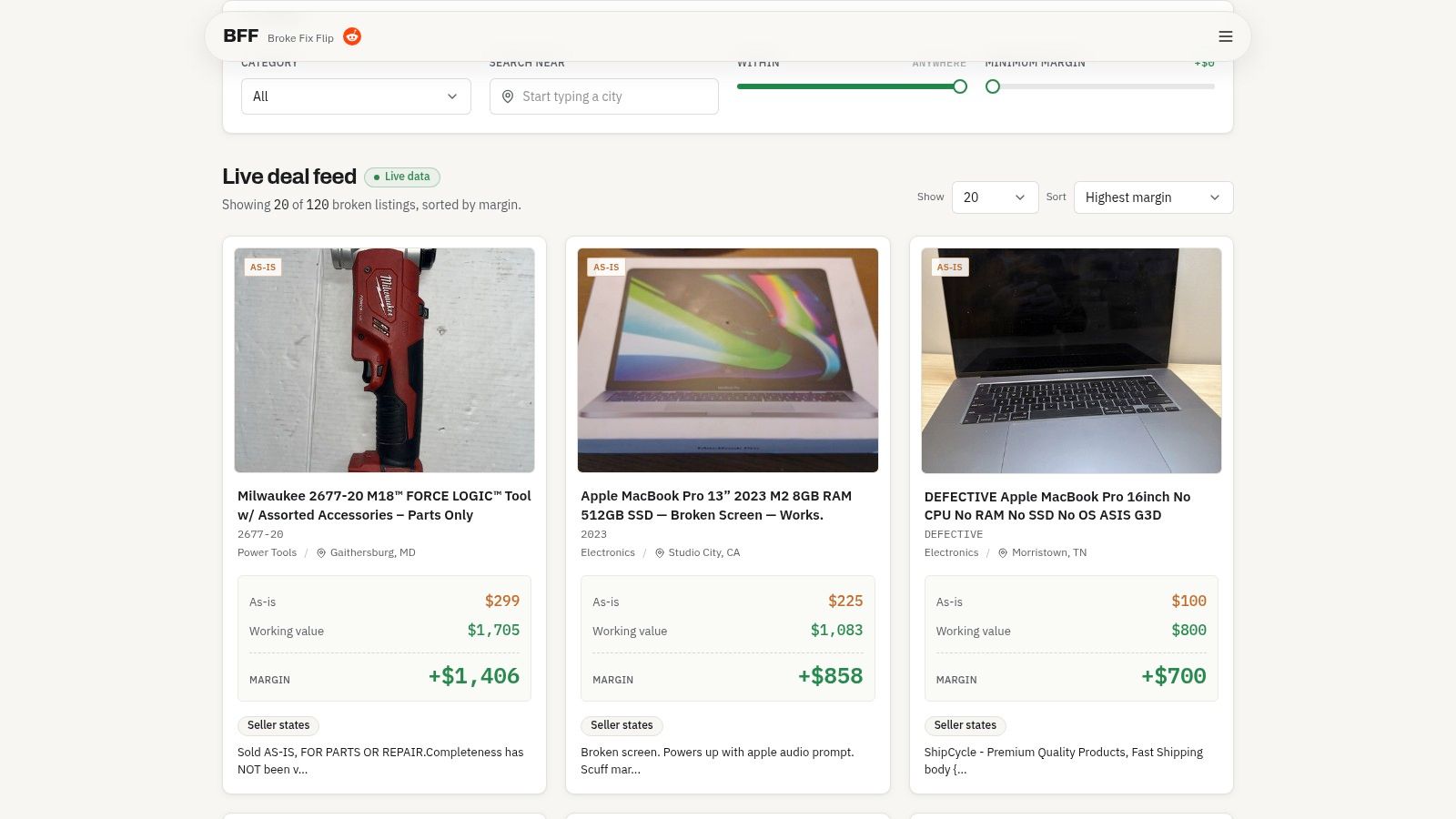
What listing language usually means
Certain phrases tend to repeat, and they don't all carry the same risk.
- "Powers on, no further testing" can be workable. It at least confirms a board response.
- "Screen cracked, touch works" is often easier to underwrite because the failure is visible.
- "Untested" can mean untested, or it can mean the seller doesn't want to commit.
- "Does not power on" needs restraint. It might be a battery, charge port, fuse, or a serious board fault.
- "For parts or not working" is a category label, not a diagnosis.
Photos matter as much as the title. Swollen battery gaps, missing screws, bent frames, charger burn marks, sticker residue around seams, and mismatched bottom screws all say more than generic text. A laptop with a clean palm rest and one shattered corner tells a different story from a laptop that has pry marks all around the case.
A few photo checks save time:
- Port condition: USB-C and Lightning ports show abuse fast.
- Hinge alignment: A twisted hinge often means hidden case or display cable problems.
- Back glass and frame corners: On phones, impact pattern hints at what else may be wrong.
- Serial or model labels: The exact sub-model changes both repair cost and resale value.
Working value has to come first
A buyer can't judge the as-is price in a vacuum. A 2025 study by the Reseller Profitability Index found that 74% of small-scale flippers miss profitable flips because they can't quickly compare as-is prices against median working values, and that data is usually absent from mainstream auction sites. That's the central blind spot.
The practical fix is simple. Estimate what the exact model sells for when working, then decide whether the listing has enough room for repair and resale. One common reseller method is to average recent sold prices for the same model in working condition. The method described in this eBay price checker workflow guide lines up with how experienced flippers avoid inflated active listings.
Active listings show seller hopes. Recent sold listings show what buyers actually paid.
That distinction matters with examples like a MacBook Air listed "for parts" with a battery warning, or a Nikon camera body listed "untested" without a charger. A current asking price from another seller isn't proof of market value. A cluster of recent working sales is much closer to reality.
When buyers auction electronics online without this step, they usually anchor to the wrong number. They see a broken laptop at a low price, assume the upside is large, and only later discover that the repaired working value isn't much higher than their total cost.
Calculating repair costs and your true profit margin
The resale side is only half the math. Repair cost is where weak flips fall apart.
Common faults beat vague optimism
The fastest way to lose money is to price a repair based on the cheapest possible explanation. A seller writes "no power" on a MacBook. One buyer assumes a battery. Another checks the model's common failures and prices several likely paths before bidding. The second buyer stays in business longer.
That difference shows up often enough to measure. According to a 2025 industry report by the National Institute of Electronics Repair, 68% of buyers overestimate profitability because they lack access to model-specific fault pricing for as-is items. That's exactly why generic "repair cost" guesses fail.
A practical repair estimate usually includes four layers:
- Likely fault from seller description. Cracked screen, bad battery life, charge issue, fan noise, hinge damage, no display.
- Common alternate fault for that model. A phone with "black screen" may need more than display glass. A laptop with "won't charge" may need board work, not just a port.
- Part sourcing reality. OEM pull, aftermarket, donor board, or refurbished part. Availability matters as much as price.
- Labor and rework risk. Even when labor isn't billed separately, time has to count. Adhesive-heavy phones and glued display assemblies have a different margin profile from RAM and SSD swaps.
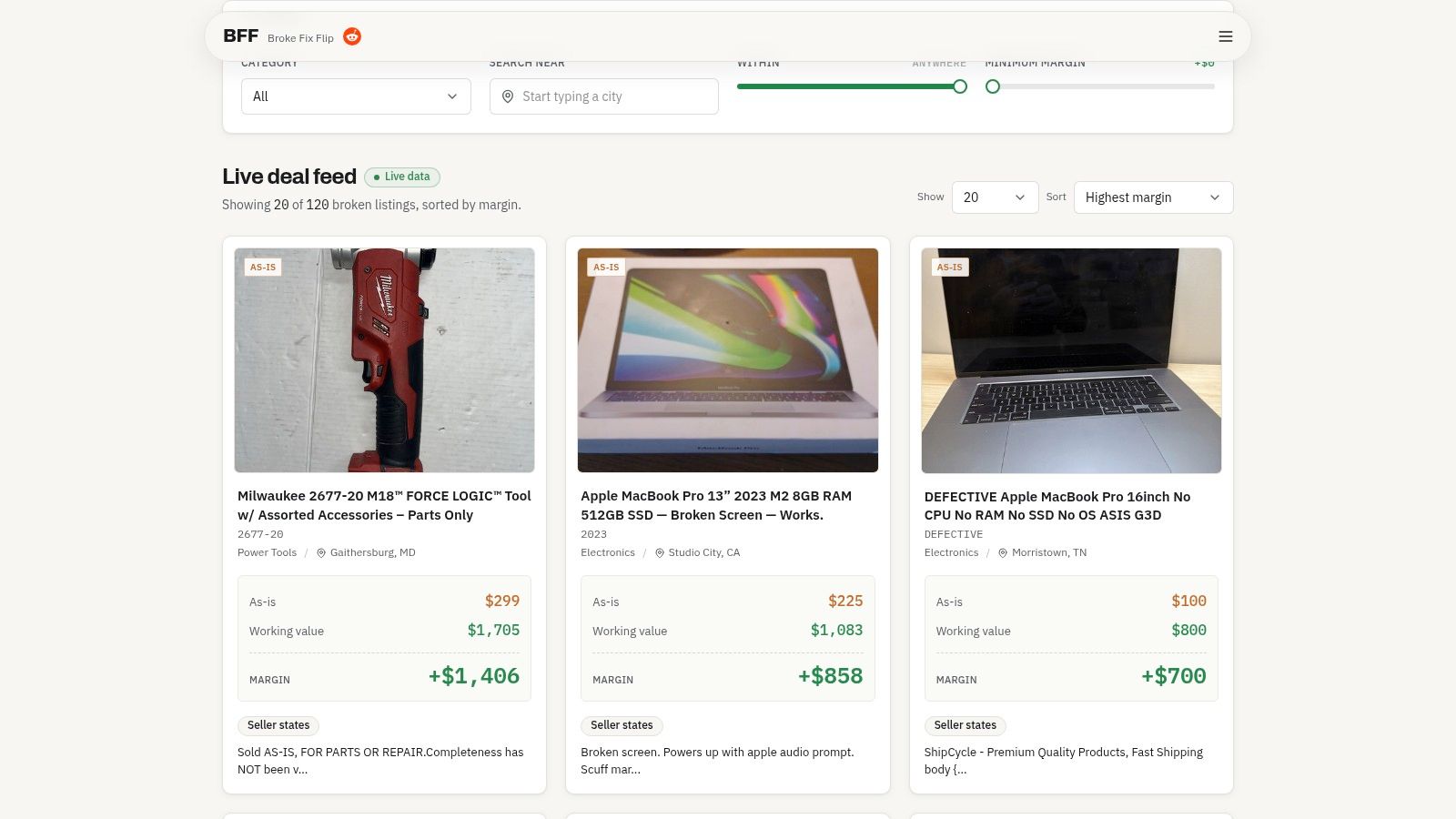
Every Broke Fix Flip listing pairs the likely fault with an estimated part cost and the margin left after the repair, so the estimate leans on realistic fault paths instead of one best-case number.
A simple margin example
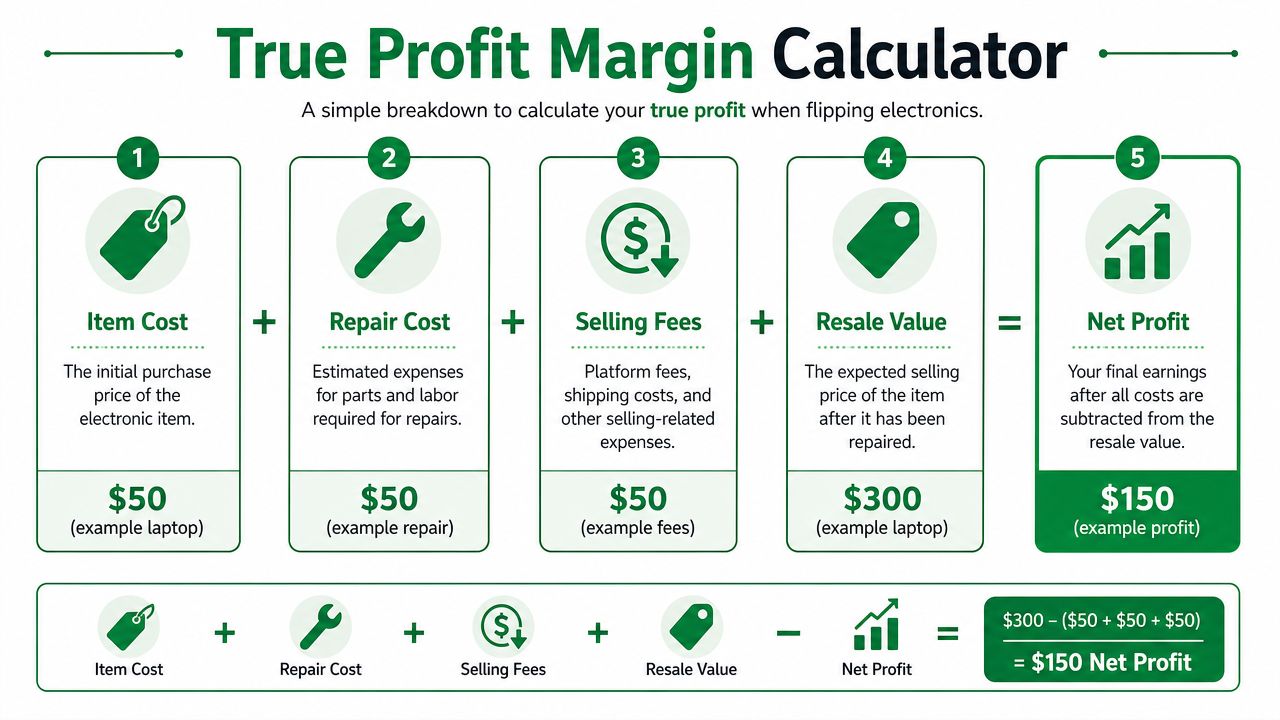
The cleanest way to price a flip is with one formula:
Estimated working resale value - (buy price + repair cost + selling costs) = potential profit
A simple example makes the logic obvious. Consider a broken laptop bought for $50, with $50 in repair cost, $50 in selling fees and shipping, and an expected resale value of $300. That leaves $150 in potential profit. Those values are example math from the infographic above, not a market claim for any specific model.
That same structure works on real categories:
- Cracked iPhone: Strong if working resale is stable and screen cost still leaves room.
- Business laptop with no SSD: Often straightforward if the rest of the machine is clean.
- "No power" MacBook: Only attractive when the likely board path has been priced conservatively.
- Camera body with battery door damage: Sometimes better as a part-out than a full repair.
A second check helps avoid weak buys. Broken electronics can still contain valuable internal components worth $10 to $500+ depending on the model and age, according to PayMore's guidance on broken electronics value. That means part-out value can rescue a deal, but it shouldn't be the default plan unless the buyer already knows which components move.
The best flips have two exits. Repair and resell if the fault is what it seems. Part out if teardown reveals a deeper issue.
Smart bidding strategies and safe buying practices
The right buy price is decided before the auction ends. Once bidding starts, discipline matters more than enthusiasm.
Max bid first, excitement second
A lot of new flippers treat auctions like contests. That's expensive. The better approach is to calculate a strict max bid from the spread and let other bidders overpay if they want the item more.
There's a solid reason for that restraint. To achieve a net profit on eBay after repair, fees, and shipping, the resale price of a repaired electronic must be at least 2.0x to 3.0x the total cost of acquisition, because fees and postage can consume 25% to 30% of the final sale price, as discussed in this EEVblog forum thread on repair profitability. That threshold keeps a flip from looking profitable on paper while producing almost nothing after friction.
A practical bidding framework looks like this:
- Start with the likely working resale value.
- Back out the likely repair path.
- Back out selling costs.
- Leave enough room for mistakes.
- Bid once with a number that still works if the auction is won.
Some buyers prefer a late bid. Others place a maximum early and walk away. The method matters less than the ceiling. A disciplined early max bid often works well because it removes the temptation to "just go a little higher" in the final seconds.
Safety checks before any bid goes in
Smart buying isn't only about margin. It's also about avoiding sellers and listings that raise the odds of a bad surprise.
A quick pre-bid checklist helps:
| Check | What to look for | Why it matters |
|---|---|---|
| Seller history | Consistent electronics sales, clear photos | Better chance the listing is described with some competence |
| Return policy | Whether as-is really means final sale | Determines how much risk sits on the buyer |
| Shipping terms | Combined shipping, insurance, packaging quality | Fragile gear can lose margin before it arrives |
| Description gaps | Missing accessories, passcodes, account locks | Some problems make repair irrelevant |
| Photo consistency | Same item in all photos, visible serial area | Reduces bait-and-switch risk |
The safest bid is often the one skipped. A listing with vague wording, no charger test, poor photos, and expensive shipping can still be profitable. It just needs a much lower buy price than the auction crowd usually gives it.
If the listing creates uncertainty in three different ways, the bid has to shrink to match.
Tracking deals and scaling your flipping operation
Two weeks into steady buying, the simple system usually starts to fail. Listings are spread across tabs, sold prices sit in another window, repair notes live in a phone app, and one underpriced lot disappears while you are still checking comps. That is the point where a flipper needs a process, not more browser tabs.
Manual tracking stops working once volume picks up
At low volume, bookmarks and saved searches are enough. After that, the same few tasks eat time on every listing: identify the exact model, check recent sold prices, estimate the likely fault, price the parts, add shipping, and decide whether the spread survives. New resellers lose margin here because they move too slowly on good inventory and too quickly on weak inventory.
The bottleneck is not finding listings. The bottleneck is first-pass math.
A better setup puts broken and for-parts listings in one workflow so you can sort by the numbers that matter. The goal is to review more inventory without doing the same resale and repair math from scratch every time. If a tool cuts ten minutes of checking from each listing, that time goes back into sourcing, testing, and repairs that pay.
Build a workflow around spread, not excitement
Scaling works better when every listing goes through the same filter before you bid or buy:
- Category focus: Stick to a few product types where failure patterns and resale values are familiar.
- Expected resale value: Use recent sold listings, not asking prices.
- Repair cost estimate: Include parts, consumables, your time, and the chance the first diagnosis is wrong.
- Total landed cost: Item price, buyer fees, tax, shipping, and any missing accessories you need to replace.
- Minimum spread: Set a floor for acceptable gross profit and pass on anything below it.
- Status tag: Watch, bid, bought, arrived, repaired, listed, sold, or scrap.
That last point matters more than it sounds. Once units start arriving every week, loose tracking creates expensive mistakes. Parts get ordered twice. Tested units sit on a shelf unlisted. A low-margin repair takes bench time away from a cleaner flip.
For buyers treating this like a real operation, Broke Fix Flip Pro is relevant because alerts, broader search coverage, and saved searches reduce the time between a listing appearing and a decision getting made. The Broke Fix Flip guides also help tighten the judgment behind those filters, especially if you are still learning which faults are cheap fixes and which ones turn into parts donors.
Growth comes from better selection and better tracking. Buy fewer bad units, review more listings per hour, and keep a clean record of what each model returns after repair. That is how the spread stops being a guess and starts acting like a system.
See the math on real listings
Broke Fix Flip scans broken and for-parts listings and shows the margin, the likely fault, and the repair cost on each one.